
The Invisible Load
The mental (invisible) load that South Asian women carry and a lived experience.
Sumati Sharma · · 4 min read
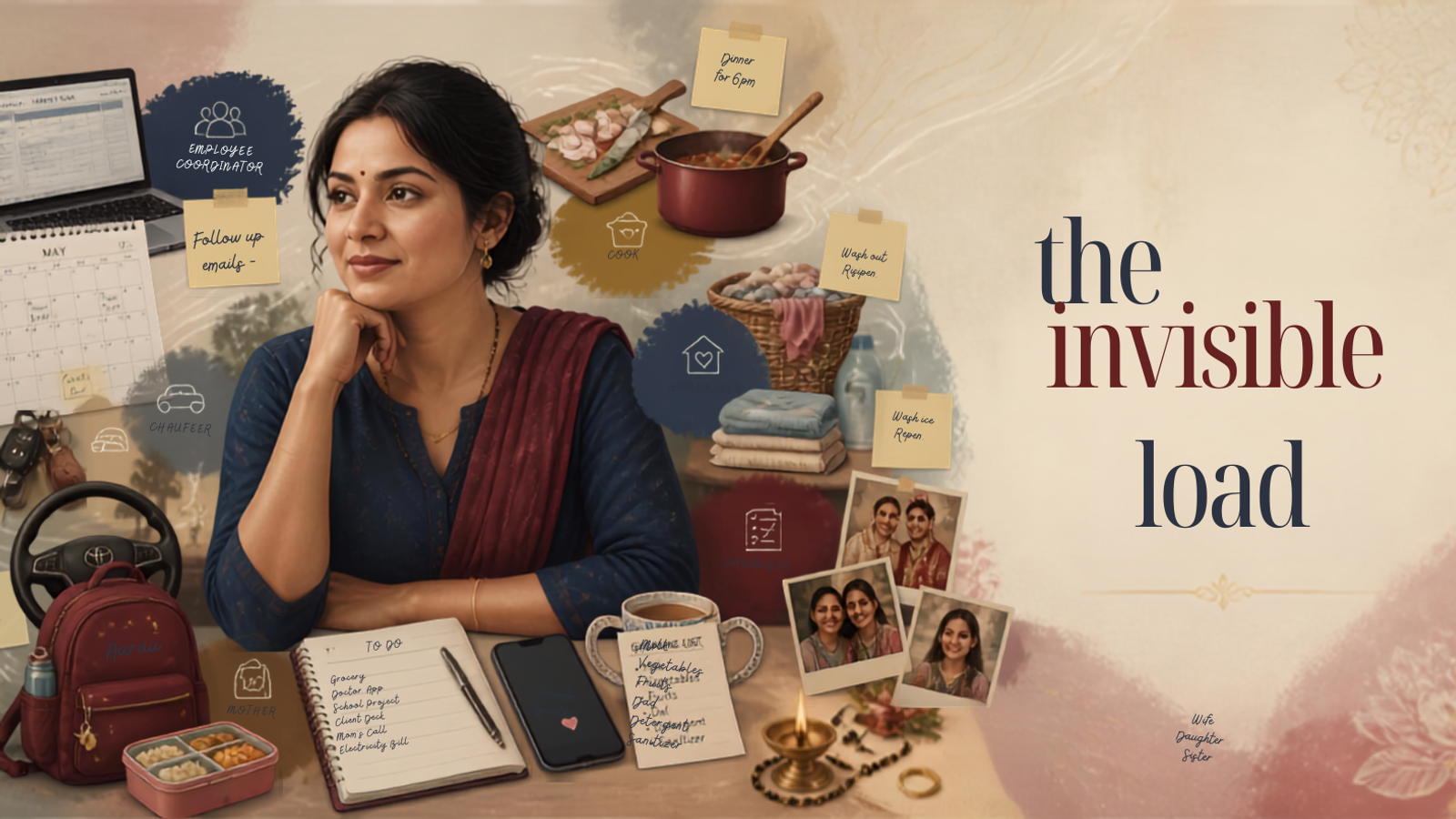
Holding It All Together: The Invisible Load of South Asian Women
The day I graduated with my Master of Social Work was also the day I began growing a little human.
There was something almost symbolic about it. One chapter of my life was beginning professionally while another was beginning personally.
What I didn’t know then was how much motherhood would change not only my life, but the way I moved through the world.
Since then, I’ve worn a lot of hats: mother, wife, daughter, sister, daughter-in-law, therapist, business owner, caregiver, chauffeur, meal planner, household manager…and whatever else the day requires.
Some days I wear those hats with confidence.
Other days, I’m barely holding them all together (more often than not).
When Your Heart Is Somewhere Else
There are moments in motherhood that no one really prepares you for.
Like dropping your kids off at daycare when they’re 4 and 1, then driving to work to spend the day caring for other people. Even when you know they’re safe and loved, that little voice can still ask:
“Am I a good enough mother if I’m not the one caring for them?”
Then there’s the juggling act of caring for your children while also being there for your in-laws, parents, partner, work, and everyone else who needs you.
Sometimes, you have to choose.

Who needs me more today? Who can wait? Who am I letting down?
And the hardest part is that sometimes there is no right choice.
You can feel guilty for choosing your children, and guilty for choosing someone else. You can feel like you’re failing everyone while desperately trying to hold everything together.
The Work Nobody Sees
Then there are the ordinary days.
You finish work and realize you have less than an hour to figure out dinner, feed everyone, gather what the kids need for their activities and somehow get everyone out the door on time.
While you’re doing that, part of your brain is already thinking about tomorrow.
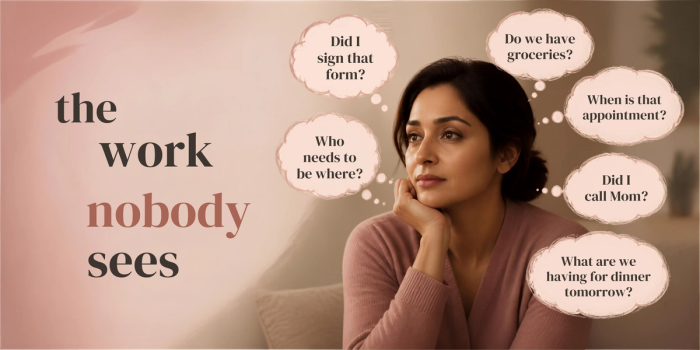
Did I sign that form? Do we have groceries? When is that appointment? Who needs to be where? Did I call Mom? What are we having for dinner tomorrow?
This is the mental load. The planning, remembering, anticipating and worrying that often happens quietly behind everything else.
For many South Asian women, there can be another layer.
We may have grown up with strong messages about caring for family, being dependable, putting others first and managing whatever comes our way.
These can be beautiful values. Caring for the people we love can bring tremendous meaning to our lives.
But somewhere along the way, caring for everyone can become carrying everyone.
And those aren’t quite the same thing.
Many South Asian women are carrying responsibilities that few people see and even fewer people acknowledge.
When Being the Strong One Gets Heavy
Sometimes the hardest part isn’t even how much you’re doing.
It’s that nobody seems to notice you’re doing it.
The appointment gets booked. The birthday gets remembered. Dinner appears. The kids get where they need to go. Someone checks in on the aging parent. The family calendar somehow works.
Life keeps moving.
So everyone assumes you’re fine.
Maybe you assume you’re fine too.
Until you’re exhausted.
Or resentful.
Or crying in the car.
Or wondering why everyone seems to need something from you when you have absolutely nothing left to give.
When you’ve spent years being the dependable one, asking for help can feel strangely uncomfortable. Rest can feel indulgent. Saying no can bring guilt. And your own needs can become something you’ll get to later.
Except later keeps moving.
I Used to Think This Was Strength
For a long time, I thought being strong meant carrying it all.
Pushing through exhaustion. Putting everyone else’s needs first. Figuring things out on my own.
But I’ve come to understand strength differently.
Strength can also be saying, I can’t do all of this by myself.
It can be asking someone else to take something off your plate without explaining why you’re overwhelmed enough to deserve the help.
It can be resting before your body forces you to.
It can be recognizing that your needs don’t become less important simply because other people need you.
And sometimes it means allowing yourself to be cared for instead of always being the person doing the caring.
Who Are You Beneath All the Roles?
Mother. Wife. Daughter. Sister. Daughter-in-law. Professional. Caregiver.
These roles can be meaningful parts of who we are.
But they aren’t all of who we are.
When so much of life revolves around what everyone else needs, it can become surprisingly difficult to answer a very simple question:
What do I need?
Maybe you don’t know right now.
That’s okay.
Sometimes reconnecting with yourself begins by simply noticing how much you’re carrying and acknowledging that it is a lot.
You don’t have to wait until you’re completely burnt out before you’re allowed to need support.
At Saath Wellness, this is one of the conversations we want South Asian women to have more openly. Not because caring for our families is something we need to leave behind, but because the woman doing all that caring deserves care too.
You are more than what you do for everyone else.
Behind all those roles is still you.
And you matter too.
Saath in wellness & healing
Sim