
Why Do I Feel Guilty All The Time?
The guilt we carry as South Asians especially as women and when it becomes too heavy.
Navneet Gill · · 7 min read

Understanding Guilt in South Asian Women
Guilt has a way of becoming so familiar that you stop noticing how much space it takes up.
Maybe you’ve apologized for setting a boundary or felt guilty for saying no to your parents. Perhaps you’ve questioned whether you were selfish for wanting time to yourself, or wondered whether choosing a different career, moving away, ending a relationship, or simply living life on your own terms somehow made you a bad daughter.
Maybe you’ve even felt guilty for being happy when someone you love was struggling. Over time, guilt becomes more than an emotion. It becomes the lens through which you make almost every decision.
One of the most common things I hear from South Asian women is:
“I just feel guilty all the time… and I don’t even know why.”
And sometimes, that’s exactly where we need to begin.
When Guilt Becomes Part of Your Identity
Guilt can be a healthy emotion. When we’ve acted in a way that goes against our values, it can help us take responsibility, repair relationships, and make different choices.
But there’s another kind of guilt that many South Asian women carry. It’s the guilt that shows up even when we haven’t done anything wrong.
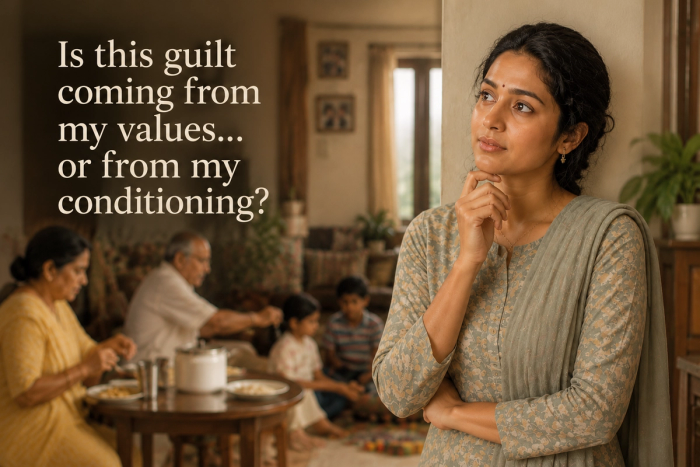
The kind that whispers:
“What if I disappoint them?”
“What if they think I’m selfish?”
“What if putting myself first hurts someone else?”
“What if I’m not being a good daughter?”
You might feel guilty for not calling your parents often enough, even when you’re juggling work, children, relationships, and responsibilities of your own. You might feel guilty for wanting a weekend to yourself, or for making a decision that your family doesn’t agree with.
Eventually, guilt stops being something you feel after doing something wrong. It becomes something you feel whenever you choose yourself.
Where Does It Come From?
In many South Asian families, children grow up with a deep awareness of sacrifice.
You know how hard your parents worked. You know what they gave up to create opportunities for you. You may have grown up hearing about the struggles they endured, the opportunities they didn’t have, and the life they worked so hard to give you.
And there’s often an unspoken understanding that family comes first. These values can come from love, connection, and a genuine sense of responsibility. But sometimes, somewhere along the way, gratitude becomes tangled with obligation.
You begin to feel that you owe your parents a particular kind of life. Making them happy is part of your responsibility. That disagreeing with them is disrespectful, or that choosing differently means you’re forgetting everything they’ve done for you.
For daughters especially, these expectations can be complicated by the roles we’re taught to play. Be respectful. Be accommodating. Don’t talk back. Don’t create conflict. Think about the family. Don’t be too outspoken or too independent. You learn to adapt, to read the room, and to figure out which version of yourself will make everyone comfortable.
And if you grew up between two cultures, you may have found yourself navigating different expectations at home and outside it. For me personally, navigating the expectations of my Punjabi upbringing while also growing into my own identity and more importantly figuring out what that looked like was very difficult because it meant standing up, going against the norms and expectations, and it meant disappointing others and even myself. You learn to adapt, to read the room, and to figure out which version of yourself will make everyone comfortable.
No one may have directly told you that your role is to keep everyone happy. Yet you may have grown up believing that someone else’s disappointment is somehow your failure.
How Guilt Quietly Shapes Your Life
Guilt doesn’t always show up in obvious ways.
Sometimes it looks like saying yes when you desperately need to say no. Sometimes it’s rehearsing a conversation ten times because you’re afraid of how someone might react.
You might explain your decisions repeatedly, hoping that if you find the right words, everyone will understand. You might soften your boundaries, apologize for having needs, or change your mind simply because someone is upset with you.
Perhaps you’re the person everyone turns to when something needs to be done. You’re dependable, responsible, and always willing to help. But when you need something, asking for it feels uncomfortable.
And sometimes the guilt is even quieter.
You might feel guilty for pursuing something you want when your parents imagined a different path for you. You might feel guilty for having a good life when a family member is struggling. You might even feel guilty for being angry or hurt by someone you love, because you know they’ve made sacrifices too.
To everyone around you, you seem thoughtful, caring, and selfless. Inside, you may feel exhausted from constantly negotiating between what you want and what everyone else needs. And after years of putting yourself last, you may reach a point where you genuinely don’t know what you want anymore.
Why This Isn’t Your Fault
One of the hardest things about conditioned guilt is that it can become an automatic response.
Think about what happens when choosing yourself has previously led to criticism, conflict, disappointment, or emotional distance.
You may have learned that keeping other people happy helps you maintain connection. That being agreeable keeps the peace. That expressing your needs risks upsetting someone or creating tension.
Over time, you begin anticipating other people’s reactions before you’ve even made a decision.
So today, even healthy choices—setting boundaries, asking for what you need, taking time for yourself—can bring up an uncomfortable wave of guilt.
Not necessarily because you’ve done anything wrong, but because you’re doing something different from what you’ve always been taught.
This is an important distinction.
Sometimes guilt comes from going against our values. Other times, it comes from going against the role we’ve learned to play.
Learning to recognize the difference can be an important part of healing.
What Healing Can Look Like
Healing isn’t about becoming someone who no longer cares about other people. It’s not about rejecting your culture, forgetting your family’s sacrifices, or deciding that your needs should always come first.
It’s about learning that caring for yourself doesn’t mean you’ve stopped caring about others.
It means slowly untangling your worth from your ability to keep everyone else comfortable.
It can begin with asking yourself a few questions:
- Am I feeling guilty because I’ve genuinely hurt someone, or because someone is unhappy with my decision?
- Am I making this choice because I want to, or because I’m afraid of disappointing someone?
- Would I expect someone I love to feel guilty for doing the same thing?
- Can I allow someone to be disappointed without immediately trying to fix it?
And perhaps one of the hardest questions:
What would I choose if I wasn’t so afraid of feeling guilty?
The answers won’t always be easy. And the guilt may not disappear simply because you’ve recognized where it comes from.
You may still feel uncomfortable the first time you say no. You may still question yourself after setting a boundary. You may still wish that your family understood your choices differently.
But with time, something begins to shift.
You stop making every decision from fear and begin making more of them from self-trust. You learn that someone else’s disappointment doesn’t automatically mean you’ve done something wrong.
You begin to understand that you can love your family, honour your upbringing, and still make room for a life that feels like your own.
And perhaps, for the first time, you begin to imagine relationships where love doesn’t have to depend on how much of yourself you’re willing to sacrifice.
A Closing Reflection

You can love your family deeply without carrying responsibility for everyone’s happiness.
You can be grateful for your parents’ sacrifices without owing them every decision about your future.
You can be compassionate without abandoning yourself.
You can choose a different path without becoming a bad daughter.
And you can disappoint someone without being a disappointment.
Your life was never meant to be measured by how much of yourself you were willing to give away.
Sometimes healing begins with one quiet realization:
You are allowed to matter, too.
Saath in wellness & healing,
Nav 🤍